

What Is a Gum Abscess?
A gum abscess is a pocket of pus that forms in the gum when
bacteria infect the tissues around a tooth. It is known medically as a periodontal
abscess, and it usually appears as a swollen, painful bump on the gum
beside the affected tooth.
Pus is a thick fluid made up of bacteria, dead tissue and the white blood
cells your body sends to fight an infection. An abscess in the mouth can form
on the gum or at the root of a tooth, and a gum abscess is the type that
starts in the gum and the tissues that hold the tooth in place.
A gum abscess is a bacterial infection, so it needs dental treatment.
Draining the pus and treating the cause of the infection usually relieves the
pain and lowers the chance of another abscess.

What Are the Symptoms of a Gum Abscess?
Gum abscess symptoms often develop quickly and are usually felt around one tooth. Common signs include:
- A swollen bump on the gum – Pus collects under the gum, so a gum abscess usually looks like a red, swollen bump beside a tooth. A white or yellow spot may show where the pus is close to the surface.
- Throbbing pain – The trapped pus presses on the tissue around it, which can cause a constant, throbbing pain in the gum.
- Pain when biting or chewing – The tissues that hold the tooth are inflamed, so pressure on the tooth can hurt, and the tooth may be sensitive to hot food and drinks.
- A bad taste or bad breath – Pus can leak from the abscess into your mouth, and it usually tastes and smells unpleasant.
- A loose tooth – The infection can damage the gum and bone that hold the tooth, so the tooth may move slightly or feel raised when you bite.
- Fever or swollen glands – A fever, or tender glands under your jaw or in your neck, can develop as your body fights the infection.
What Causes a Gum Abscess?
A gum abscess is caused by bacteria that build up in the space between a tooth and the gum, where they cause an infection and pus collects. The infection can start because of gum disease, food or an object trapped under the gum, or a partly erupted wisdom tooth.
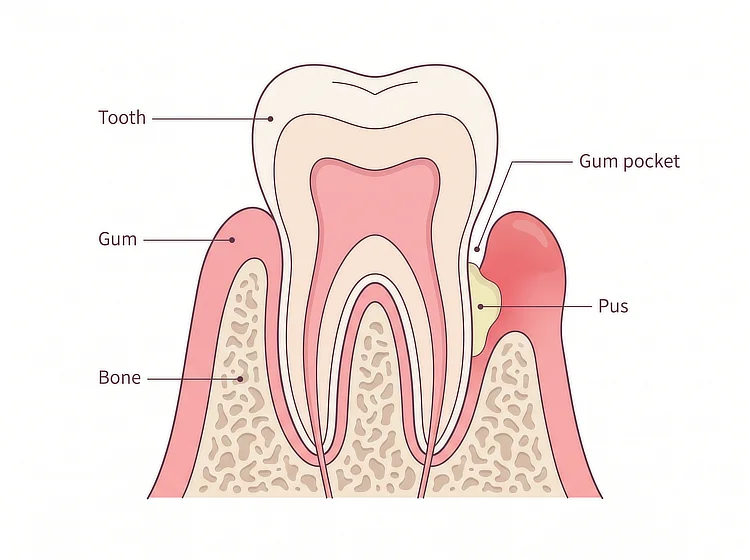
Gum Disease
Gum disease is the most common cause of the infection that leads to a gum
abscess. In advanced
gum disease (periodontitis), the gum pulls away from the tooth and
leaves a deep space called a periodontal pocket, where plaque and
bacteria collect.
An abscess can form if the opening of the pocket becomes blocked, as the pus
from the infection can no longer drain out.
Smoking and poorly controlled diabetes do not cause the infection directly,
but they raise the risk of gum
disease and can make a gum abscess more likely.
Trapped Food or Objects
A gum abscess can form in healthy gums if a small, sharp piece of food or another
object is pushed under the gum and traps bacteria there.
Common examples include a popcorn husk, a fish bone and a piece of a toothpick. This
type usually affects only the edge of the gum, and it is sometimes called a gingival
abscess.
Partly Erupted Wisdom Teeth
An abscess can form in the gum around a wisdom tooth that has only partly emerged. The tooth is often covered by a flap of gum, and food and bacteria can collect under the flap, where a toothbrush cannot reach easily. The gum can then become infected, a condition called pericoronitis, and pus may collect around the tooth.
What Is the Difference Between a Gum Abscess and a Tooth Abscess?
A gum abscess starts in the gum beside a tooth, whereas a tooth abscess starts inside the tooth and forms at the tip of its root. The two can look and feel alike, so an examination and an X-ray are usually needed to tell them apart.
| Feature | Gum abscess | Tooth abscess |
|---|---|---|
| Also known as | Periodontal abscess | Periapical abscess |
| Where it starts | In the gum and the tissues that hold the tooth in place | In the pulp, the soft centre of the tooth that contains its nerves and blood vessels |
| Cause of infection | Gum disease, food or an object trapped under the gum, or a partly erupted wisdom tooth | Deep tooth decay, a crack or an injury that lets bacteria reach the pulp |
| Main treatment | The abscess is drained and the gum pocket is cleaned | Root canal treatment, or removal of the tooth if it cannot be saved |
WhatsApp Us Now
How Is a Gum Abscess Treated?
A gum abscess is treated by draining the pus and cleaning the infected area
under the gum.
A gum abscess does not go away on
its own. The pain may ease if the abscess bursts, but the infection usually
remains until it is treated.
Treatment generally follows this order:
- Examination and X-ray – The gum and the tooth are examined first, and an X-ray is usually taken to show where the infection started and how much bone supports the tooth.
- Drainage – The gum is numbed with local anaesthetic first. The pus is then drained through the gum pocket beside the tooth or through a small cut made in the swelling, and the area is rinsed clean. Drainage usually relieves the pressure and much of the pain.
- Deep cleaning – Plaque, tartar (hardened plaque) and any trapped food or object are then removed from the root of the tooth inside the gum pocket. This step, called scaling and root planing, allows the gum to heal against the tooth, which can make another abscess less likely.
- Follow-up visit and treatment – The gum is checked again once the swelling has gone down. Further gum treatment may be planned if gum disease caused the abscess, and gum surgery may be recommended if the pocket is too deep to be cleaned by scaling and root planing.

Antibiotics are prescribed only in some cases, such as a
fever or spreading swelling, and they usually cannot cure a gum abscess without
drainage. Tooth extraction may also
be recommended if the infection has destroyed too much of the bone around the tooth
for the tooth to be kept.
Recovery time after treatment varies from person to person, and the gum usually
takes longer to heal than the pain takes to ease.
When to See a Dentist for a Gum Abscess
See a dentist as soon as
you can get an appointment if you think you have a gum abscess, even if the pain is
mild.
A gum abscess can become a medical emergency if the
infection spreads beyond the gum. Call 995 or go to the nearest Accident and
Emergency (A&E) department straight away if you have:
- Swelling that is spreading to your face, jaw or neck
- Swelling around your eye
- Difficulty swallowing, breathing or opening your mouth
- A high fever or feeling very unwell

Over 30% of adults feel anxious about dental visits.
Dental visits can indeed be stressful, but at True Dental Studio, we are gentle and patient, committed to helping you feel at ease during your visit.

Dr Tay Chih Kien
Book a Consultation for a Gum Abscess
Book Gum Abscess Consultation
Book NowEnquire More Through Email
Email Us NowEnquire More Through WhatsApp
WhatsApp Us NowWhy Choose True Dental Studio?

Friendly Dentist and Team
We treat every patient to the best of our ability. This is why families across Singapore have continued their dental care with us for years.

Minimal Discomfort
We are committed to keeping our patients as comfortable as possible, minimising any discomfort during treatment.

Affordable Treatments
We believe in pricing quality treatments at a competitive rate. We are transparent and upfront with our treatment costs.
Our Smile Scorecard
Frequently Asked Questions
No home remedy can treat a gum abscess, as none removes the pus or the infection that caused it. Rinsing gently with warm salt water, taking a painkiller, eating soft food and avoiding very hot or cold drinks may ease the discomfort for a short time. Gels or tea bags placed on the gum cannot release the pus under it. You should see a dentist as soon as possible, so that the abscess can be drained and the infection treated.
Popping or draining a gum abscess at home should be avoided. Squeezing the swelling or piercing it with a pin or needle can push bacteria deeper into the gum, injure the tissue and spread the infection. The pus also tends to collect again, because the bacteria that caused it are still under the gum. Drainage is carried out by a dentist with sterile instruments under local anaesthetic, which numbs the gum, and the area under the gum is then cleaned.
A gum abscess can burst by itself, although not all do. Pressure from the pus may open a small hole in the gum, and the pus drains into the mouth, which often eases the pain. Bursting releases the pus but leaves the bacteria under the gum, so the abscess tends to fill again. An abscess that does not burst may extend into the nearby bone or the face. Dental treatment is needed in both cases, as the source of the infection has to be cleaned out from under the gum.
Rinsing the mouth gently with warm salt water is the first step after a gum abscess pops by itself, as it helps to wash the pus away. The pus should be spat out, and the swelling should not be squeezed to force more out. Pain often eases once the pressure is released, but the bacteria usually remain in the gum and the abscess can fill again. You should still see a dentist promptly, so that the gum can be cleaned and the source of the infection treated.
Yes, brushing should continue with a gum abscess, as plaque (the sticky film of bacteria on teeth) can make the infection worse if it builds up. A soft toothbrush and gentle strokes around the swollen area can reduce the discomfort, and the swelling itself should not be scrubbed or pressed. Brushing keeps the mouth clean, but it cannot remove the pus under the gum. It is best to have the swelling assessed by a dentist, who can drain it and recommend suitable treatment.
The first signs of a gum abscess are usually a tender, swollen area on the gum beside one tooth and discomfort when biting on that tooth. The gum may look red, and the tooth can feel slightly raised or loose. Throbbing pain, a white or yellow spot of pus, a bad taste in the mouth and fever tend to follow, often quickly, as the pus builds up.
Yes, a gum abscess can be painless, particularly when the pus is able to drain. The pus may escape through the gum pocket (the space between the tooth and the gum) or through a small opening in the gum, which releases the pressure that causes the pain. A painless abscess may show only as a small bump, a bad taste or a little pus on the gum. The infection is still present and can continue to damage the bone around the tooth, so dental treatment is still needed.
Most gum abscesses feel soft or squishy, because the swelling is filled with pus, a thick fluid made of bacteria, dead tissue and white blood cells. The gum over the swelling is often tender, and pus may come out under pressure, although pressing it is not advisable. An early abscess can feel firmer before much pus has collected. A hard, painless lump on the gum may be a different condition, such as a bony growth or a cyst, and it should be examined by a dentist.
Gum abscess stages are not formally defined, but an abscess usually develops in a recognisable order. The first stage is infection, when bacteria trapped under the gum cause redness, tenderness and slight swelling. Pus then collects and forms a soft, painful bump. The abscess may next burst and drain into the mouth, which eases the pain without clearing the bacteria. An untreated infection can go on to damage the bone around the tooth or, less often, spread to the face and neck.
Conditions commonly mistaken for a gum abscess include a tooth abscess, a gum cyst, a mouth ulcer and an infected flap of gum over a wisdom tooth. A tooth abscess starts inside the tooth and can drain through the gum as a pimple-like bump, which looks much the same. These conditions are treated differently, and they often cannot be told apart by appearance alone. It is advisable to consult a dentist, who can examine the swelling, take an X-ray if needed and recommend suitable treatment.
A gum cyst is a closed sac of fluid that grows slowly and is typically painless, whereas a gum abscess is a pocket of pus from a bacterial infection that tends to become painful quickly. A cyst often feels firm and may go unnoticed until it appears on an X-ray. An abscess is usually soft, red and tender, and it may leak pus. A cyst can become infected and then behave like an abscess. Treatment also differs, as a cyst is generally removed, while an abscess is drained.
A gum ulcer is a shallow open sore, while a gum abscess is a raised swelling filled with pus. An ulcer often looks like a round white or yellow patch with a red border, stings when food touches it, and generally heals within one to two weeks. An abscess is a red, swollen bump beside a tooth that throbs and may leak pus. If you suspect a gum abscess or are unsure which one you have, you should consult a dentist, who can examine the area and recommend suitable treatment.
Children can get a gum abscess, although a swelling on a child's gum more often comes from an infected tooth than from gum disease. Tooth decay can let bacteria reach the centre of a milk tooth, and the infection may then drain through the gum as a small pimple-like bump. Food or a small object pushed under the gum can also cause an abscess. A child with a swelling on the gum should be seen by a dentist promptly, as an untreated infection can affect the adult tooth developing underneath.
A gum abscess can form after a tooth extraction or a dental cleaning, although it is not common. After an extraction, bacteria or a fragment of tooth or bone left in the socket (the hole where the tooth sat) may cause an infection. After a cleaning, the gum can tighten over a gum pocket (the space between the tooth and the gum) and trap bacteria or loosened tartar (hardened plaque) inside it. Swelling, pus or increasing pain after either procedure should be reviewed by the dentist who carried it out.
No, a gum abscess is not contagious, as the abscess itself cannot pass from one person to another. The bacteria that cause tooth decay and gum disease can, however, be passed on through saliva, for example by kissing or by sharing cutlery or a toothbrush. Picking up these bacteria does not mean an abscess will form, since an abscess develops only where bacteria become trapped, such as in a deep gap between a tooth and the gum.
Gum abscesses generally last until they are treated, as the infection does not clear by itself. The pain and swelling may ease for a while if the abscess bursts or drains, and then return days or weeks later. After the abscess has been drained and the infection treated by a dentist, the pain usually improves quickly, while the gum takes longer to heal, and the healing time varies from person to person.
An untreated gum abscess can keep damaging the gum and the bone that support the tooth, so the tooth may loosen and need removal. The infection can also reach the pulp, the soft centre of the tooth, which then needs root canal treatment. Less often, the infection spreads to the jaw, face or neck and causes swelling, fever and difficulty swallowing or breathing. Seek urgent medical attention if you have any of these symptoms.
Recurring gum abscesses usually mean that the original cause is still present. The most common reason is a deep gum pocket (a space between the tooth and the gum) from gum disease, where hardened plaque remains on the root of the tooth. A crack in the root, a tooth whose nerve has died or poorly controlled diabetes can also be responsible. It is advisable to ask your dentist whether further gum treatment is needed, based on the depth of the gum pockets and the condition of the tooth.
There is no instant way to get rid of a gum abscess, and home remedies or painkillers do not remove it. Relief generally comes soonest from drainage by a dentist, as releasing the pus takes away the pressure that causes most of the pain. The area under the gum is then cleaned so that the infection can clear. Recovery is often faster when the abscess is treated early.
Antibiotics alone do not usually cure a gum abscess. They can reduce the bacteria and the swelling for a time, but they cannot remove the pus that has already collected or the plaque (a sticky film of bacteria) under the gum that led to the infection. The abscess therefore tends to return once the course of antibiotics ends. Antibiotics are generally prescribed alongside drainage, and only when there is fever, spreading swelling or a health condition that makes infections harder to fight.
Drainage through the gum may not be suitable for every abscess. A firm swelling with no pocket of pus has no pus to release yet. A tooth abscess, which starts inside the tooth, not the gum, is typically drained through the tooth during root canal treatment (removal of the infected tissue inside it) or tooth removal. Antibiotics may be prescribed before drainage if the infection is spreading. It is best to discuss with your dentist the most suitable treatment, based on where the infection started and whether pus has formed.
Root canal treatment is not usually needed for a gum abscess, because the infection is in the gum and not inside the tooth. Root canal treatment removes infected pulp, the soft tissue at the centre of a tooth, so it is the usual treatment for a tooth abscess. A gum abscess may need it as well if the infection has reached the pulp from the gum, or if tests show that the pulp has died. An examination and an X-ray generally show which type of abscess is present.
A dentist, not a doctor, is the professional who treats a gum abscess, as the treatment involves draining the pus and cleaning the gum and tooth. A general practitioner (GP) can assess the swelling and may prescribe painkillers or antibiotics, but a GP cannot carry out dental treatment, so the abscess is likely to return. Swelling that spreads to the face, eye or neck, or difficulty swallowing or breathing, needs care at an Accident and Emergency (A&E) department straight away.