

What Is a Dry Socket?
Dry socket is a painful condition that can develop after a tooth extraction,
when the blood clot in the empty tooth socket fails to form or
breaks down too early. The medical name for dry socket is
alveolar osteitis, which means inflammation of the bone around a tooth
socket.
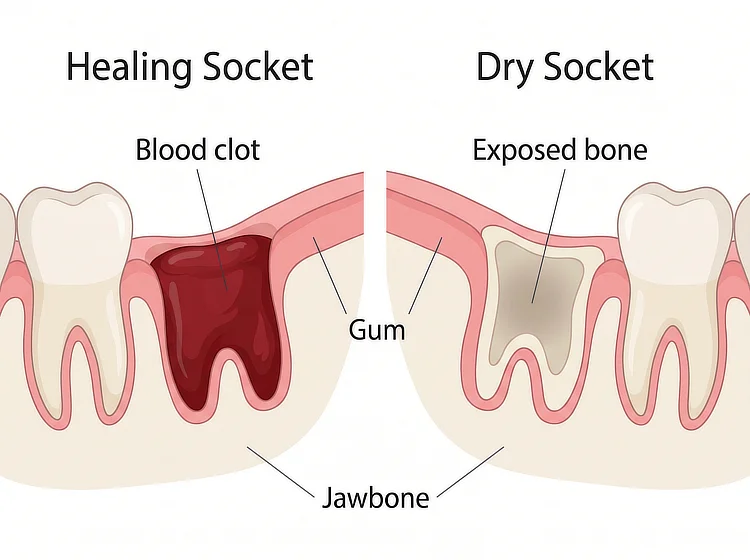
A blood clot normally fills the socket after a tooth is removed. The clot
protects the bone and nerve endings underneath and forms the base for new
gum and bone to grow. Without the clot, the bone is left exposed to air,
food and fluids in the mouth, which causes pain and delays healing.
Dry socket affects about 2 to 5 in 100 tooth
extractions. It is much more common after lower
wisdom teeth are removed, where it can affect around 3 in 10
extractions.
What Causes a Dry Socket?
Dry socket happens when the blood clot in the socket dissolves too early, fails to form, or is dislodged before the socket heals. The exact trigger is not fully understood, but these risk factors make it more likely:
- A difficult extraction – Surgical extractions, such as removing an impacted lower wisdom tooth, injure more of the surrounding bone. Lower wisdom teeth carry the highest risk of any tooth.
- Smoking – Smokers are more than three times as likely to develop dry socket, as tobacco can slow healing and sucking on a cigarette can loosen the clot.
- Oral contraceptives – Oestrogen in the contraceptive pill is thought to make the clot break down more easily.
- Disturbing the clot – Straws, spitting, vigorous rinsing or touching the socket in the first few days may dislodge the clot.
- Poor oral hygiene – Bacteria around the socket are thought to contribute to the clot breaking down.
- A previous dry socket – Having had dry socket before makes it more likely to happen again.

How Do You Know If You Have Dry Socket?
Dry socket symptoms usually appear 1 to 5 days after a tooth extraction, when normal soreness should be easing. Common signs include:
- Pain that gets worse – A severe, throbbing ache from the exposed bone that can spread to the ear, eye, temple or neck on the same side.
- Little relief from painkillers – Over-the-counter medicines often do not take the pain away.
- Bad breath or a bad taste – Food debris and bacteria collecting in the open socket can cause an unpleasant smell or taste.
- An empty-looking socket – Whitish bone may be visible at the bottom of the socket in place of a dark blood clot.
WhatsApp Us Now
Dry Socket vs Normal Healing
Dry socket and normal healing differ mainly in how the pain changes over the days after the extraction, and in what the socket looks like.
| Sign | Dry Socket | Normal Healing |
|---|---|---|
| Pain over time | Gets worse 1 to 5 days after the extraction | Usually strongest in the first day or two, then eases each day |
| Where the pain is felt | Often spreads to the ear or temple | Usually stays around the extraction site |
| What the socket looks like | Looks empty, with whitish bone visible at the bottom | Filled with a dark red blood clot, similar to a scab |
| Smell and taste | Bad breath or an unpleasant taste is common | No lasting bad taste |
| Response to painkillers | Painkillers often bring little relief | Over-the-counter painkillers usually ease the soreness |
Can Dry Socket Heal on Its Own?
Dry socket can heal on its own, as it is a delay in healing that does not usually
cause lasting harm. The pain can be severe in the meantime, though.
Professional treatment does not make the socket heal much faster, but it can shorten
the time spent in severe pain.
How Long Does Dry Socket Last?
Dry socket usually heals within 7 to 10 days, as new tissue gradually grows over the exposed bone. With treatment, the pain often eases within a few days.
How Is Dry Socket Treated?
Dry socket usually needs in-clinic treatment when painkillers do not ease the pain. Treatment involves cleaning the socket and covering the exposed bone with a medicated dressing.
Cleaning the Socket
Your dentist first checks the socket, sometimes with an X-ray to confirm that no fragment of tooth or bone is left behind. A sterile saline solution or an antiseptic may then be used to gently rinse out food debris and bacteria, often after a numbing gel or local anaesthetic is applied.

Dry Socket Paste
Dry socket paste is a medicated dressing packed into the cleaned socket. It usually
contains soothing, numbing ingredients such as eugenol (a compound found in clove
oil). The paste covers the exposed bone and can bring quick pain relief.
The dressing is applied at a dental clinic, not at home, and may be replaced every
other day if the pain continues.
How to Relieve Dry Socket Pain at Home
Home care can ease the pain between dental visits. Paracetamol or ibuprofen, taken
as directed, can also help.
Keep brushing and flossing as usual, but stay clear of the socket. Avoid smoking, as
it can slow healing. Drink plenty of water to stay hydrated while eating is
uncomfortable.
Always follow your dentist's instructions on pain relief and caring for the socket,
and return sooner if the pain gets worse.
How to Prevent Dry Socket
You can lower your risk of dry socket by protecting the blood clot in the first few days after an extraction. Practical steps include:
- Avoid smoking until the socket has healed.
- Skip straws for at least a week, as sucking may pull the clot out.
- Rinse and spit gently, tilting your head to let liquid flow out of your mouth.
- Eat soft foods such as porridge, eggs and yoghurt, and chew on the other side of your mouth.
- Avoid hot and fizzy drinks while the socket heals.
- Use a chlorhexidine mouthwash if your dentist recommends one, as it has been shown to lower the risk.
- Tell your dentist before the extraction if you smoke, take the contraceptive pill or have had dry socket before.
Follow the aftercare instructions your dentist gives you, as they are based on how your tooth was removed.

Over 30% of adults feel anxious about dental visits.
Dental visits can indeed be stressful, but at True Dental Studio, we are gentle and patient, committed to helping you feel at ease during your visit.

Dr Tay Chih Kien
Book an Appointment for Dry Socket
Book Dry Socket Appointment
Book NowEnquire More Through Email
Email Us NowEnquire More Through WhatsApp
WhatsApp Us NowWhy Choose True Dental Studio?

Friendly Dentist and Team
We treat every patient to the best of our ability. This is why families across Singapore have continued their dental care with us for years.

Minimal Discomfort
We are committed to keeping our patients as comfortable as possible, minimising any discomfort during treatment.

Affordable Treatments
We believe in pricing quality treatments at a competitive rate. We are transparent and upfront with our treatment costs.
Our Smile Scorecard
Frequently Asked Questions
Antibiotics are not usually needed for dry socket, as the problem is a missing blood clot and exposed bone, not an infection. Treatment typically involves gently cleaning the tooth socket and placing a medicated dressing (a soothing paste packed over the bone) to relieve the pain. A dentist may prescribe antibiotics when an infection is suspected, or for people with a weakened immune system.
Dry socket pain is not usually immediate. Soreness straight after an extraction is normal and tends to ease a little each day, while dry socket pain typically starts 1 to 5 days later, most often around day 2 or 3, and grows stronger. A rise in pain after an initial improvement is the pattern most associated with dry socket. The pain is often described as a deep, throbbing ache that can spread towards the ear.
Pain from a dry socket has no fixed score on a 1 to 10 scale, because pain tolerance varies from one person to another. It is commonly described as severe, and often stronger than the soreness that follows the extraction itself. The pain tends to throb, may spread to the ear or temple, and often responds poorly to over-the-counter painkillers.
Dry socket without pain is uncommon, because pain that worsens a few days after an extraction is its main symptom. Pain is usually what separates dry socket from normal healing, where soreness eases a little each day. A socket that looks empty but feels less sore over time is generally healing as expected. A bad taste, a bad smell or bone visible in the socket can still point towards dry socket even when the pain is mild.
Yes, a dry socket can look whitish, because the white area is often bare bone at the bottom of the tooth socket once the blood clot has gone. Normal healing can look white too. After a few days, the dark clot is gradually replaced by granulation tissue (soft new healing tissue), which often looks white, cream or pale yellow. Colour alone therefore does not confirm dry socket, and increasing pain, a bad taste and a socket that looks empty are more reliable signs.
Dry socket often causes an unpleasant, bitter or foul taste, along with a bad smell that many people notice as persistent bad breath. Food debris and bacteria can collect in the empty tooth socket once the protective blood clot is lost, and their breakdown is thought to produce the taste and odour. The taste usually lasts until the socket is cleaned and starts to heal.
Bleeding is not usually a feature of dry socket, because the problem is that the blood clot in the tooth socket has broken down or been lost, leaving the socket looking empty. Small amounts of blood in the first day or so after an extraction are normal, and the bleeding tends to lessen steadily over the first week. Heavy or ongoing bleeding is a separate problem from dry socket and should be checked by the dentist who carried out the extraction.
The riskiest time for dry socket to develop is the first 5 days after an extraction, when the blood clot is still fragile and has not yet been replaced by healing tissue. Dry socket pain most often begins around the second or third day. The risk then falls steadily and has usually passed once the socket has healed, which generally takes 7 to 10 days.
Three days after an extraction is usually too early to stop watching for dry socket, as it can still develop up to about day 5. Day 3 often falls in the period when dry socket pain begins, so the more useful sign is whether the pain is easing or growing. Soreness that eases a little each day is typical of normal healing, while pain that grows stronger is not. You should contact the dentist who did your extraction if the pain becomes stronger or starts to spread towards your ear.
The risk of dry socket is highest in the first few days after an extraction and usually passes once the tooth socket has started to heal. Most dry sockets appear between day 1 and day 5, so a socket that keeps getting less painful after about day 5 is unlikely to develop one. Full healing of the gum over the socket generally takes 7 to 10 days. It is advisable to contact the dentist who removed your tooth if the pain starts increasing instead of easing.
Dry socket is not especially easy to cause by accident, and it develops after only about 2 to 5 in 100 extractions. It can, however, follow habits that disturb or loosen the blood clot in the first few days, such as sucking through a straw, smoking, spitting or touching the socket with the tongue or a finger. Some cases also happen without any obvious mistake, since a difficult extraction or the contraceptive pill can make the clot break down more easily.
Stitches do not prevent dry socket, because they hold the edges of the gum together but do not stop the blood clot inside the tooth socket from breaking down. Stitches are often placed after a surgical extraction, such as removing an impacted wisdom tooth (one stuck under the gum or bone), which already carries a higher risk of dry socket. The usual aftercare, such as avoiding smoking and straws early on, therefore still applies with stitches in place.
Throwing up and strong coughing can both put pressure on the blood clot in a tooth socket, and forceful vomiting in the first few days after wisdom teeth removal may dislodge it. Ordinary coughing is probably less likely to disturb the clot than vomiting or the suction created by drinking through a straw. If you vomit repeatedly, notice signs such as worsening pain or a bad taste, or are worried about dry socket, you should consult the dentist who carried out the procedure.
Talking is thought to be unlikely to cause dry socket, as normal speech does not create the suction or pressure that can dislodge a blood clot from a tooth socket. Long periods of talking in the first day or two may make the jaw and gums feel more sore, so resting the jaw can help ease that soreness. The actions more often linked to a dislodged clot involve suction or force, such as smoking or drinking through a straw.
Normal swallowing is generally considered unlikely to cause dry socket, as gentle swallowing does not create the suction that can pull a blood clot out of a tooth socket. The movements more often linked to a dislodged clot are sucking through a straw, spitting, forceful rinsing and smoking. Letting saliva and drinks flow down without swishing them around the mouth, and tilting the head so a rinse drains out gently, may help protect the clot while it is still fragile.
Drinking plenty of water supports healing after an extraction, but it does not prevent dry socket on its own. Staying hydrated also keeps the mouth moist when eating can be uncomfortable after the extraction. Avoiding suction and force matters more for the clot: sipping from a glass is gentler than drinking through a straw, and swishing water forcefully around the mouth should be avoided early on. Hot and fizzy drinks are also best avoided while the socket heals.
No, dry socket is not an infection. It is a delay in healing that happens when the blood clot in the tooth socket breaks down or is lost, leaving the bone underneath exposed to air, food and fluids. An infection can still develop in the socket, though, and its signs differ from those of dry socket: fever, swelling that keeps growing, or pus coming from the socket. These signs need prompt assessment by a dentist.
Dry socket rarely causes lasting harm, as the tooth socket generally heals within 7 to 10 days. Its main effect is pain, which can be severe and often does not ease with over-the-counter painkillers. Cleaning the socket and placing a medicated dressing over it can relieve that pain. Dry socket is not usually an emergency, but a high temperature, spreading swelling or pus from the socket can signal an infection that needs prompt attention.
The Chinese term for dry socket is 干槽症 (gān cáo zhèng), which translates literally as 'dry socket condition'. The medical term, alveolar osteitis (inflammation of the bone around a tooth socket), is 牙槽骨炎 (yá cáo gǔ yán) in Chinese. Both terms describe the same painful problem that can follow a tooth extraction, when the blood clot in the socket breaks down too early.